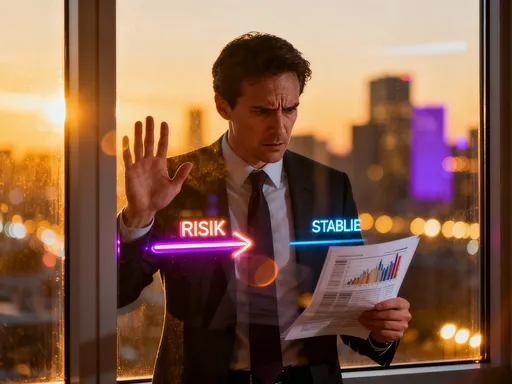
How I Stopped Losing Sleep Over Market Swings — My Real Risk-Hedging Move
I used to check my portfolio every hour, heart racing every time the market dipped. I thought investing was just about chasing returns — until I nearly lost everything during a sudden crash. That’s when I realized: protecting what you have matters more than chasing what you don’t. This is the risk response strategy I built through trial, error, and real fear — not textbook theory. It’s practical, it’s tested, and it changed how I see money forever. The journey wasn’t glamorous. There were no shortcuts, no secret formulas whispered by Wall Street insiders. Just hard-earned lessons, repeated mistakes, and a growing awareness that true financial strength isn’t measured by peak gains, but by how much you keep when the tide goes out. This is how I learned to stop reacting to every market whisper and start building lasting stability.
The Wake-Up Call: When Risk Hit Home
It happened on a Tuesday morning, the kind most people forget. I was making coffee when I glanced at my phone and saw a red sea across my portfolio. The market had dropped nearly 8% overnight — a correction, some called it. To me, it felt like a collapse. In a matter of hours, six months of gains had evaporated. I remember sitting at the kitchen table, unable to move, staring at the numbers as if they might change if I just waited long enough. I didn’t sell. I didn’t buy. I did nothing — paralyzed by fear and regret. Looking back, the real loss wasn’t just financial. It was the sleepless nights that followed, the constant anxiety, the way I started second-guessing every financial decision I’d ever made. I had poured time and money into building what I thought was a solid investment plan, but in reality, it was built on sand.
What I didn’t realize then was that I wasn’t investing — I was speculating. I had chased high-growth stocks without understanding their volatility, ignored warning signs in the economic data, and assumed that past performance guaranteed future results. I had no plan for when things went wrong, only hopes for when they went right. That crash was my wake-up call. It forced me to confront a truth many investors avoid: risk isn’t an abstract concept. It’s personal. It shows up in your heartbeat when the market drops, in the way you snap at your family after a bad trading day, in the fear that one more loss might mean starting over at a time in life when you can’t afford to. For me, that moment wasn’t just about money. It was about peace of mind, security, and the kind of future I wanted for my family.
What changed wasn’t luck or a sudden windfall. It was a shift in perspective. I began to see investing not as a race to get rich, but as a long-term effort to preserve and grow wealth without losing sleep. I started asking different questions: What’s the worst that could happen? How much can I afford to lose? What would I do if this investment dropped 30% tomorrow? These weren’t questions of greed. They were questions of survival. And answering them honestly led me to the concept of risk hedging — not as a complex financial maneuver, but as a practical, everyday strategy for protecting what matters most.
What Risk Hedging Really Means (And What It Doesn’t)
When I first heard the term risk hedging, I pictured complicated derivatives, hedge fund managers in tailored suits, and strategies too complex for ordinary people to understand. I assumed it was something only professionals used, and even then, mostly to make big bets. But over time, I learned that hedging isn’t about complexity — it’s about common sense. At its core, risk hedging means reducing your exposure to potential losses without completely stepping out of the market. It’s not about avoiding risk altogether — that’s impossible if you want any return. Instead, it’s about managing risk intelligently, so that one bad outcome doesn’t derail your entire financial plan.
Think of it like insurance. You don’t buy car insurance because you plan to crash. You buy it because you can’t afford the consequences if you do. The same logic applies to investing. Hedging isn’t a sign of fear or lack of confidence. It’s a sign of responsibility. It acknowledges that markets are unpredictable, economies shift, and even the best-laid plans can go wrong. The goal isn’t to eliminate all risk — that would mean keeping all your money in a mattress, which carries its own dangers, like inflation eroding your purchasing power. The goal is to build a financial structure that can withstand shocks, adapt to change, and keep you moving forward even when conditions are tough.
One of the biggest misconceptions I had to overcome was that hedging is too expensive or only for the wealthy. In reality, many effective hedging strategies are low-cost and accessible. Diversifying your portfolio, holding cash, using stop-loss rules, or investing in stable assets like dividend-paying stocks or bonds — these aren’t exotic tools. They’re practical steps anyone can take. Another myth is that hedging means missing out on big gains. That’s not necessarily true. While some hedging strategies may limit upside in bull markets, they also prevent catastrophic losses in downturns. And in the long run, avoiding a 50% loss is far more valuable than capturing an extra 10% gain. It’s simple math: losing 50% requires a 100% return just to break even. Protecting your capital isn’t conservative — it’s essential.
The Three Layers of My Protection Strategy
After my wake-up call, I knew I needed a better approach. I didn’t want to abandon investing — I still believed in its power to build wealth over time. But I needed a system that could protect me from my own emotions and the market’s unpredictability. I developed a three-layer strategy that has become the foundation of my financial resilience. Each layer serves a distinct purpose, and together, they create a balanced defense that allows me to stay invested without living in fear.
The first layer is asset diversification. Most people think of diversification as simply owning different stocks or funds. But real diversification goes deeper. It’s about choosing assets that respond differently to the same economic conditions. For example, when stocks fall during a recession, bonds often hold steady or even rise. Real estate might decline in value, but rental income can continue. International markets may perform differently than domestic ones. I now spread my investments across asset classes that are not highly correlated — meaning they don’t move in lockstep. This doesn’t guarantee I won’t lose money, but it reduces the chance that everything will collapse at once. I also diversify within categories: different sectors, company sizes, and geographic regions. This way, if one part of the market struggles, others may hold up or even thrive.
The second layer is position sizing. This is one of the most overlooked but powerful tools in risk management. Position sizing means deciding how much of your portfolio to allocate to any single investment. Early on, I made the mistake of putting too much into a few “sure thing” stocks. When one of them dropped 40%, it hurt my overall portfolio more than it should have. Now, I follow a simple rule: no single investment can exceed 5% of my total portfolio. This limits the damage if something goes wrong and forces me to think carefully before making large bets. It also prevents emotional attachment to any one holding. If a stock I own drops, I can assess it objectively, not through the lens of panic or pride.
The third layer is defensive assets. These are investments that tend to hold their value or generate steady income even when markets are volatile. For me, this includes high-quality bonds, dividend-paying stocks, and cash equivalents. These assets don’t usually deliver explosive growth, but they provide stability and income. During market downturns, they act as a buffer, reducing the overall volatility of my portfolio. They also give me the flexibility to take advantage of opportunities when prices are low. Instead of being forced to sell losing positions to raise cash, I can use income from defensive assets or draw from cash reserves. This layer is my anchor — it keeps me grounded when the financial winds howl.
How I Use Stop-Loss Rules Without Overreacting
One of the hardest lessons I learned was how to manage losses without letting fear take over. I used to avoid stop-loss orders because I worried they would trigger during normal market fluctuations and lock in losses unnecessarily. I imagined selling at the bottom, only to watch the price recover the next day. That fear kept me from using a tool that could have saved me from bigger losses. Over time, I realized that the problem wasn’t stop-loss rules — it was how I was using them. I had set them too tight, based on arbitrary percentages, without considering the natural volatility of each investment.
Now, I use a more thoughtful approach. I set stop-loss levels based on historical price movements and market conditions, not fixed rules like “sell if it drops 10%.” For example, if a stock typically swings 5% in a day, setting a 7% stop-loss might make sense. But for a more stable stock, I might use a tighter threshold. I also use trailing stop-loss orders, which adjust automatically as the price rises. This lets me lock in gains while still protecting against sharp declines. Most importantly, I treat stop-loss rules as part of my discipline, not a reaction to emotion. They’re like guardrails on a mountain road — not meant to be hit, but there to keep me from going off the edge if I lose control.
The key is consistency. I apply these rules to every position, not just the ones I’m nervous about. This removes the temptation to make exceptions based on hope or sentiment. It also helps me avoid the paralysis that comes from trying to time the market. I don’t need to predict the future — I just need a plan for what to do if things go wrong. And when a stop-loss triggers, I don’t see it as a failure. I see it as a success — the system worked. I protected my capital, lived to invest another day, and avoided the much larger losses that can come from holding on too long.
Why Cash Isn’t Dead — It’s a Weapon
For years, I believed the common wisdom: cash is dead. It earns no returns, loses value to inflation, and is a sign of fear or indecision. I tried to keep as little as possible, always looking for the next investment to deploy every spare dollar. But that mindset left me vulnerable. When the market dropped, I had no dry powder. I was fully invested, with no flexibility to act. I couldn’t buy undervalued assets because I had nothing to buy with. That changed when I started viewing cash not as a dead asset, but as a strategic tool.
Now, I maintain a core cash reserve of about 10–15% of my portfolio. This isn’t idle money — it’s active capital waiting for opportunity. It gives me the freedom to act when others are forced to sell. During market downturns, while panic spreads and prices fall, I can selectively invest in high-quality assets at discounted prices. This isn’t about timing the bottom — that’s impossible. It’s about being prepared to act when valuations make sense. Having cash on hand also reduces emotional pressure. I don’t feel the need to sell winning positions just to raise money for new investments. I don’t have to sell losing ones at a loss to cover expenses. Cash gives me breathing room.
Some worry that holding cash means missing out on long-term growth. That’s a valid concern, but it’s also a short-term view. The cost of holding cash is small compared to the cost of being forced to sell at the worst possible time. Markets reward patience and discipline, not constant activity. By holding cash strategically, I’m not avoiding risk — I’m managing it. I’m choosing when to take risk, rather than having it thrust upon me. This shift in mindset has been one of the most powerful changes in my financial life. Cash isn’t a sign of fear. It’s a sign of readiness.
Learning from Mistakes: What I’d Do Differently
If I could go back, I wouldn’t change the crash that scared me. I’d change how I responded to it — or rather, how I hadn’t responded before it happened. I made every classic mistake: ignoring diversification, overconcentrating in a few stocks, using leverage without understanding the risks, and following trends without doing my own research. I once doubled down on a losing position because I couldn’t accept being wrong. I sold winners too early out of fear and held losers too long out of hope. Each mistake cost me money, but more importantly, it cost me confidence.
One of the biggest mental shifts came when I stopped seeing hedging as a sign of weakness. I used to think that real investors didn’t need protection — that they embraced risk and rode through every storm. But the more I studied successful long-term investors, the more I realized that the best ones aren’t the most aggressive. They’re the most resilient. They focus on survival first, growth second. They know that staying in the game matters more than winning every hand. This changed how I measure success. I no longer judge my progress by how high my portfolio goes during a bull market. I judge it by how well it holds up during a downturn — and how calmly I can respond.
I also learned to accept that not every dip requires action. Early on, I felt like I had to do something every time the market moved. I’d tweak my portfolio, switch strategies, or chase the latest hot stock. Now, I’ve embraced patience. I review my plan regularly, but I don’t react to noise. I’ve built systems — like my three-layer strategy and stop-loss rules — that work automatically. This has reduced stress and improved results. The biggest lesson? Financial confidence doesn’t come from hitting home runs. It comes from avoiding strikeouts. It comes from knowing you have a plan, sticking to it, and trusting that over time, consistency beats heroics.
Building a Risk-Aware Mindset for the Long Game
Today, my approach to money is fundamentally different. I no longer see investing as a way to get rich quickly. I see it as a way to build lasting security, protect what I’ve worked for, and create a stable foundation for my family’s future. This isn’t about fear — it’s about respect. I respect the power of markets, the unpredictability of the economy, and the influence of my own emotions. That respect has led me to adopt a risk-aware mindset, one that shapes every financial decision I make.
Now, I evaluate every investment not just by its potential return, but by its potential downside. I ask: What could go wrong? How much could I lose? How would I respond? This doesn’t make me risk-averse. It makes me risk-informed. I still take calculated risks, but I do so with eyes open. I focus on staying in the game over decades, not making a killing in a single year. I’ve learned that the most powerful force in investing isn’t leverage or timing — it’s time itself. Compounding works best when you avoid large losses that reset your progress.
This mindset didn’t make me wealthy overnight. But it did make me calmer, more consistent, and far less likely to make costly mistakes. I sleep better. I worry less. I enjoy life more. And over time, that peace of mind has translated into better financial outcomes. Because when you’re not reacting to fear, you can make clearer, more rational decisions. You can stick to your plan. You can keep investing through the ups and downs, knowing you’re built to last. That’s the real goal — not to chase every gain, but to build a financial life that endures. And that, more than any single investment, is the foundation of lasting wealth.